
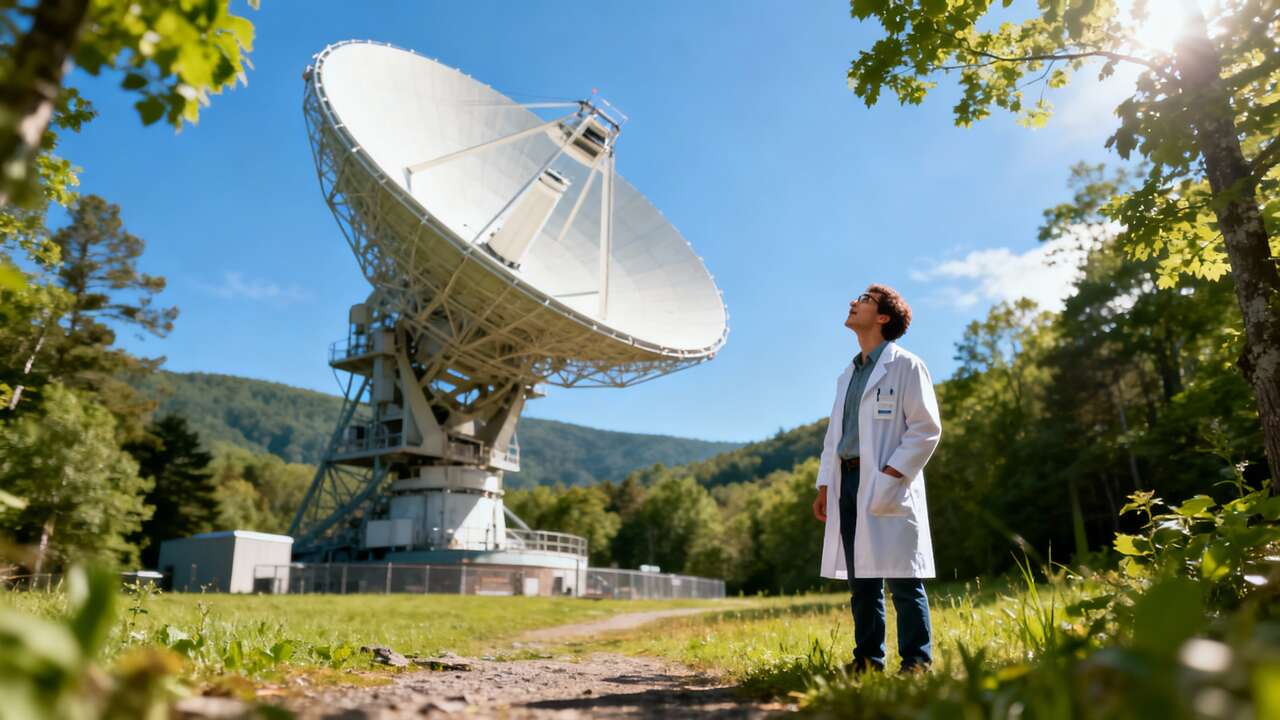

In the rolling hills of West Virginia, a small town exists as a curious anomaly in our hyper-connected world. Green Bank, home to a world-class astronomical observatory, enforces a strict ban on the technologies that define modern life. Here, the air is intentionally kept free of the invisible chatter of WiFi signals, cell phone calls, and other forms of wireless communication. This deliberate silence is not for the sake of nostalgia but is a critical requirement for a scientific mission of cosmic proportions. The town’s unique regulations create a lifestyle that is both a challenge and a refuge, forcing a reliance on older technologies and fostering a community bond that many feel has been lost in the digital age. This article delves into the reasons behind Green Bank’s electronic quietude, exploring the history, the science, and the human experience within America’s quietest town.
A town without WiFi: green Bank in West Virginia
The National Radio Quiet Zone
Green Bank is situated at the heart of the National Radio Quiet Zone (NRQZ), a vast 13,000-square-mile area established by the federal government in 1958. This designation imposes severe restrictions on electromagnetic radiation to protect the sensitive instruments at the Green Bank Observatory. Within this zone, and especially in the 10-mile radius immediately surrounding the observatory, the rules are the strictest. The goal is to create an environment of near-perfect radio silence, allowing astronomers to listen to the faintest whispers from the universe. This means residents and visitors must forgo many modern conveniences.
A life unplugged
Living in Green Bank means adapting to a world without the constant hum of wireless technology. The restrictions are comprehensive and actively enforced. Prohibited devices and activities include:
- Cell phones, which have no service and are generally required to be turned off.
- WiFi routers, which are completely illegal.
- Bluetooth devices, including headphones and speakers.
- Microwave ovens, as their high-powered signals can disrupt astronomical observations.
Residents rely on landline telephones, payphones, and dial-up or wired fiber-optic internet connections. This forced disconnection from the wireless world shapes a unique social fabric, where face-to-face interaction is the norm and the pace of life is noticeably slower. The origins of this mandated silence are deeply rooted in the nation’s scientific ambitions during the dawn of the space age.
The history of radio silence
A site chosen for its seclusion
The story of Green Bank’s electronic silence began in the mid-1950s when the U.S. government sought a location for a new national radio astronomy facility. Scientists needed a place shielded from the growing cacophony of man-made radio signals that were beginning to saturate the country. The valley where Green Bank is located, nestled within the Allegheny Mountains, provided a perfect natural barrier. The surrounding mountain ranges effectively block radio waves from distant cities, creating a naturally quiet environment ideal for listening to the cosmos. This geographical advantage made it the prime candidate for what would become a world-renowned scientific institution.
The legal framework for quiet
Recognizing that natural shielding alone would not be enough to protect the observatory from future technological growth, scientists petitioned for legal protection. In 1958, the Federal Communications Commission (FCC) officially established the National Radio Quiet Zone. This act of federal regulation was a landmark decision, carving out a massive piece of the country where scientific research would take precedence over commercial and private wireless communications. The establishment of the NRQZ cemented Green Bank’s destiny as a town where the needs of science dictate the rules of daily life, a principle that continues to explain the strict ban on modern wireless devices.
Why does Green Bank ban wireless devices ?
The threat of radio frequency interference
The primary reason for the ban is to prevent Radio Frequency Interference (RFI). The radio telescopes at the Green Bank Observatory are incredibly sensitive instruments, designed to detect celestial signals that are billions of times weaker than the signal used by a standard cell phone. A single wireless device operating nearby can completely overwhelm these faint cosmic messages, rendering the telescopes useless. It is analogous to trying to hear a pin drop during a rock concert. The energy collected by the Green Bank Telescope from a distant galaxy over an entire year is less than the energy of a single falling snowflake hitting the ground.
A comparison of signal strengths
To understand the scale of the problem, it is helpful to compare the power of everyday electronic signals to the cosmic signals astronomers study. The difference is astronomical, highlighting why even the smallest source of local interference is a significant threat.
| Signal Source | Typical Power (Watts) |
|---|---|
| Cell Phone Signal (at tower) | 100 W |
| WiFi Router | 0.1 W |
| Cosmic Radio Source (as received on Earth) | 0.000000000000000000000001 W |
This immense disparity illustrates that even a malfunctioning microwave oven or a passing car with a faulty spark plug can be a source of catastrophic interference. To protect its mission, the observatory must maintain this pristine radio environment, a task that falls to the institution at the center of the quiet zone.
The role of the Green Bank Observatory
A jewel of modern astronomy
At the heart of the quiet zone stands the Green Bank Observatory (GBO), home to the Robert C. Byrd Green Bank Telescope (GBT). The GBT is the world’s largest fully steerable radio telescope, a colossal structure taller than the Statue of Liberty with a dish spanning 2.3 acres. Its immense size and precision allow it to observe vast portions of the sky and detect incredibly faint radio waves from distant stars, galaxies, and other cosmic phenomena. The GBO is a facility of the National Science Foundation and serves as an essential tool for astronomers worldwide, who come to Green Bank to conduct cutting-edge research.
A legacy of discovery
Since its inception, the observatory has been at the forefront of astronomical discovery. Its telescopes have played a crucial role in expanding our understanding of the universe. Key contributions include:
- The first detection of the radio emissions from Jupiter’s magnetic field.
- The discovery of the first organic molecules in interstellar space.
- The creation of detailed maps of the Milky Way galaxy’s spiral arms.
- Pioneering work in the search for gravitational waves and the study of pulsars.
The continued success of this scientific enterprise depends entirely on maintaining the radio silence that the NRQZ provides. This requirement, however, creates a growing friction with the expectations and technologies of the 21st century.
Challenges of modernity in a zone of silence
The relentless advance of technology
Maintaining a 13,000-square-mile zone of radio silence is an increasingly difficult task in a world saturated with wireless technology. The proliferation of satellites, the expansion of cellular networks to the zone’s borders, and the constant introduction of new wireless gadgets create a persistent threat. The observatory employs a dedicated team of engineers who act as “radio police,” using specialized equipment to patrol the area, hunt down sources of illegal interference, and educate the public. These engineers have traced interference to everything from faulty electric blankets to unauthorized wireless cameras, showcasing the constant vigilance required to protect the observatory’s work.
Balancing science and community needs
The strict regulations create a fundamental tension between the scientific mission and the needs of a modern community. While some residents cherish the quiet, others find the lack of connectivity isolating and economically disadvantageous. Businesses struggle to operate without modern payment systems, and emergency services face communication challenges. The town must navigate the desire for economic development and tourism with the absolute necessity of preserving its radio silence. This delicate balancing act means that every decision about infrastructure and community life is weighed against its potential impact on the telescopes, a reality that shapes the daily experience of everyone living within the zone.
Living without modern technologies: challenges and adaptations
A different rhythm of life
For the residents of Green Bank, life proceeds without the constant notifications and digital distractions that define existence elsewhere. Communication relies on older, more deliberate methods. Landline phones are essential, and a handful of public payphones remain in operation. Social plans are made in advance, as there is no way to send a quick text to change them. This environment has attracted a small community of people with electromagnetic hypersensitivity, who seek refuge from the wireless signals they believe cause them physical illness. For most, however, it is simply a unique way of life that requires patience and creative problem-solving.
Ingenious adaptations
Residents have developed numerous adaptations to thrive in the quiet zone. While wireless internet is forbidden, wired connections are permitted, and a growing fiber-optic network provides high-speed access to some homes and businesses. This allows for modern work and education, albeit tethered to a cable. Other adaptations include:
- Using pagers for emergency services and essential personnel.
- Relying on community bulletin boards and local newspapers for information.
- Fostering a strong culture of neighborliness and mutual support.
These adjustments create a community that is remarkably self-reliant and deeply interconnected on a human level, a byproduct of the technological silence imposed upon them.
Green Bank, West Virginia, stands as a living experiment in balancing scientific progress with the pervasive march of technology. Its mandated quiet is not an escape from modernity but a necessary condition for exploring the universe. The town’s residents navigate a unique set of challenges, adapting their lives to protect the sensitive work of the Green Bank Observatory. In doing so, they have cultivated a community that values direct communication and a slower pace of life. Green Bank remains a testament to the idea that sometimes, to hear the most profound signals from far away, one must first create a space of profound silence here on Earth.

- This Central American country is the new Costa Rica - 1 November 2025
- This “floating” sauna in a Norwegian fjord is the ultimate Scandi experience - 1 November 2025
- Why this small US town is the “Christmas Capital” of America - 1 November 2025