
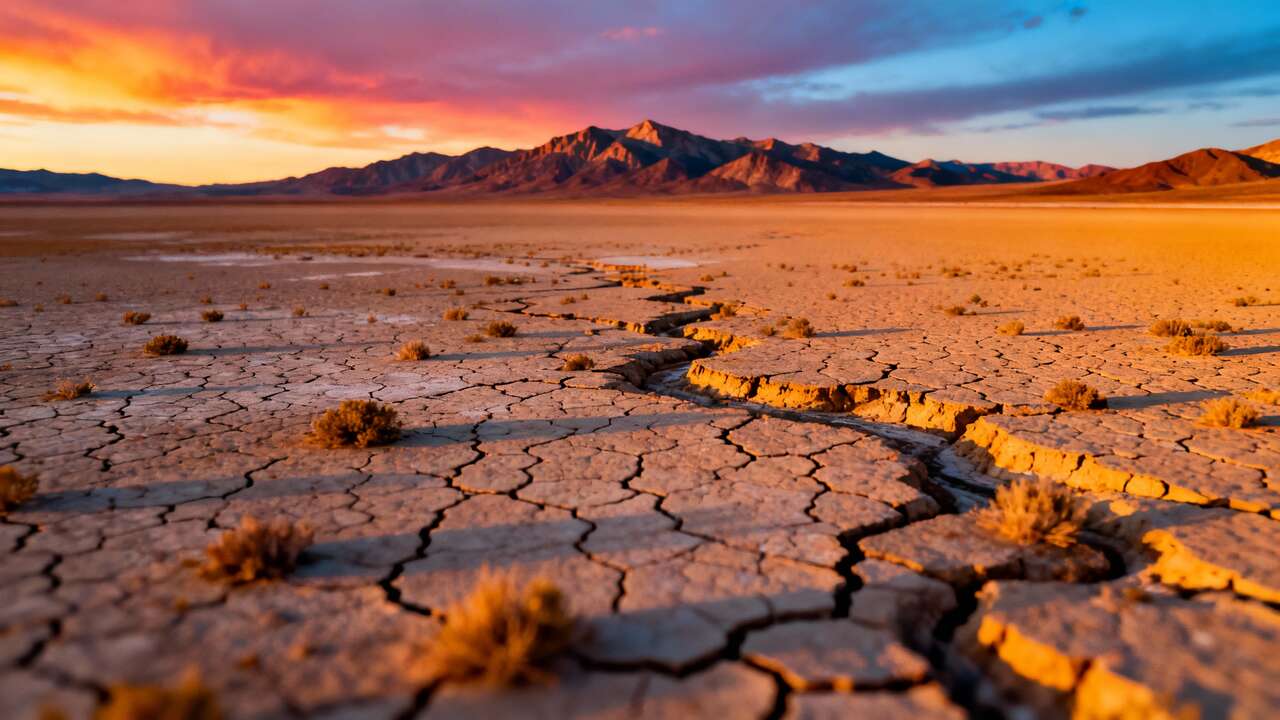

When one pictures Oregon, images of dense, evergreen forests, a rugged coastline, and persistent rainfall often come to mind. Yet, tucked away in the state’s southeastern corner lies a landscape so stark and vast it seems to belong to another world entirely. The Alvord Desert, a massive, flat playa, challenges every preconceived notion of the Pacific Northwest. This is not the land of moss-covered trees but of cracked earth, shimmering heat waves, and an immense, uninterrupted sky. It is a place of profound silence and surprising life, a geological marvel that was once the bed of a deep, ancient lake. For the traveler willing to venture off the beaten path, it offers an experience of solitude and raw beauty that is increasingly rare.
Discovering the Alvord Desert, a Hidden Gem of Oregon
A Lakebed’s Legacy
The Alvord Desert is, in geological terms, a playa, which is an alkali flat or dry lake bed. This expansive, twelve-by-seven-mile plain was once submerged beneath Lake Alvord, a massive body of water that could reach depths of 200 feet during the Pleistocene epoch. As the climate shifted and became more arid, the lake evaporated, leaving behind the fine sediments and mineral deposits that form the desert floor today. The surface is exceptionally flat, creating a unique canvas for the dramatic weather patterns that sweep across the region. During the dry summer months, the ground bakes into a mosaic of cracked mud, hard enough to drive on.
The Rain Shadow Effect
The desert’s extreme aridity is a direct result of its location. The formidable Steens Mountain, rising to nearly 10,000 feet just to the west, creates a powerful rain shadow. Weather systems moving eastward from the Pacific Ocean are forced to rise over the mountain, cooling and releasing their moisture on the western slopes. By the time the air descends on the eastern side, it is dry and warm, leaving the Alvord Desert with an average of only seven inches of precipitation annually. This phenomenon is responsible for creating one of the driest places in Oregon, a stark contrast to the temperate rainforests found just a few hundred miles away.
Understanding the geological and climatic forces that shaped this unique environment provides a foundation for appreciating its place on the map. The very isolation that preserves its character also defines its location far from the state’s major population centers.
Where Is the Alvord Desert Located ?
A Remote Corner of the State
The Alvord Desert lies within Harney County in the remote southeastern quadrant of Oregon. It is part of the Great Basin, a large, arid region that stretches across several western states. The desert is framed by Steens Mountain to the west and the Trout Creek Mountains to the east, creating a long, narrow basin. This is a sparsely populated area, known more for its sprawling cattle ranches and rugged terrain than for towns or cities. The nearest community with significant services, such as a large grocery store or hospital, is Burns, which is a considerable drive away.
Gauging the Distance
Its remoteness is a key part of its appeal, but it requires significant travel time. For most visitors, reaching the Alvord Desert is a dedicated road trip, not a casual day trip. The journey itself is part of the experience, taking travelers through some of Oregon’s most scenic and least-traveled landscapes. To put the location into perspective, consider the driving distances from major regional hubs.
| Starting Point | Approximate Driving Time | Approximate Distance |
|---|---|---|
| Portland, Oregon | 7 – 8 hours | 350 miles |
| Bend, Oregon | 4 – 5 hours | 200 miles |
| Boise, Idaho | 3.5 – 4 hours | 180 miles |
| Burns, Oregon | 2 hours | 110 miles |
Knowing exactly where this desert is located is the first step, but the practicalities of navigating the final miles into this isolated basin require careful planning and an understanding of the local road network.
How to Access the Alvord Desert ?
Navigating the Final Stretch
The primary route into the Alvord Desert basin is the Fields-Denio Road, a mostly gravel road that runs north-south along the eastern flank of Steens Mountain. From the north, travelers typically take Highway 78 from Burns before turning south. From the south, access is via Highway 205 and then onto the Fields-Denio Road. While generally well-maintained, this road can be washboarded and dusty in the summer and potentially muddy or impassable after rain or snow. It is essential to check conditions before departing.
Driving on the Playa
One of the most unique aspects of the Alvord Desert is the ability to drive directly onto the playa surface, but this should only be done when it is completely dry. The hard-packed surface can feel as solid as pavement, but moisture can lurk just beneath the crust. If the surface appears dark, damp, or has standing water, do not attempt to drive on it. A vehicle can easily sink into the mud, and with limited cell service and professional help hours away, getting stuck can become a serious emergency. The main access points to the playa are unpaved tracks leading off the Fields-Denio Road, with the most popular being near Alvord Hot Springs.
Successfully navigating the roads to and across the desert is a challenge that depends heavily on the time of year, as weather dramatically alters the landscape and accessibility.
When Is the Best Time to Visit the Alvord Desert ?
Seasonal Considerations
The Alvord Desert experiences extreme temperatures, and choosing the right season is crucial for a safe and pleasant visit. The weather can change rapidly, and visitors should be prepared for a wide range of conditions regardless of the time of year.
- Spring (April – June): This is often considered an ideal time to visit. Temperatures are moderate, and the surrounding landscape may feature a surprising bloom of wildflowers. However, spring can also be windy, and the playa is more likely to be wet and impassable from winter runoff or spring rains.
- Summer (July – September): The playa is almost guaranteed to be dry, making it perfect for driving, camping, and landsailing. However, daytime temperatures can soar well above 100°F (38°C), and there is virtually no shade. Visits during this time require careful management of sun exposure and hydration. The nights, however, are often pleasantly cool and perfect for stargazing.
- Autumn (September – November): Like spring, fall offers milder temperatures and stable conditions. The playa is typically dry from the summer, and the crowds begin to thin. This season provides a great balance of accessibility and comfortable weather.
- Winter (December – March): Visiting in winter is for the most prepared and adventurous. Temperatures often drop below freezing, and snow is possible. The playa is frequently a shallow, frozen lake or a muddy expanse, making it inaccessible to vehicles.
Once you have selected the best season for your trip, you can begin to explore the wide array of activities that this unique destination has to offer.
Must-Do Activities in the Alvord Desert
Embracing the Expanse
The vast, open playa is a playground for activities that are impossible in most other places. Landsailing and kiteboarding are popular, as the flat surface and steady winds create perfect conditions. Simply driving across the uninterrupted plain, with the vastness stretching out in every direction, is an experience in itself. For photographers, the desert offers unparalleled opportunities. The stark landscape, the dramatic texture of the cracked earth, and the unobstructed views of sunrises and sunsets over Steens Mountain create a minimalist and powerful aesthetic.
Stargazing and Celestial Wonders
With its remote location far from any city lights, the Alvord Desert is a designated Dark Sky area. The lack of light pollution provides an extraordinary view of the night sky. On a clear, moonless night, the Milky Way stretches from horizon to horizon in breathtaking detail. It is a prime location for amateur astronomers and astrophotographers, or simply for anyone wishing to experience the profound sense of wonder that comes from gazing into a truly dark sky. Dispersed camping is permitted on the public land of the playa, allowing for an immersive overnight experience under the stars.
Soaking in Geothermal Springs
A surprising feature of this arid region is its geothermal activity. Several hot springs are located along the desert’s edge, offering a perfect way to relax after a day of exploration.
- Alvord Hot Springs: This is a privately-owned facility that maintains two concrete soaking pools. It offers a comfortable and accessible way to enjoy the mineral-rich thermal water with views out over the playa.
- Mickey Hot Springs: Located north of the main playa, this is a more primitive and wild geothermal area. It features bubbling mud pots and steaming, colorful pools that are too hot for soaking but fascinating to observe from a safe distance.
Engaging in these incredible activities requires an understanding that you are in a wild and unforgiving environment, making careful preparation an absolute necessity.
Tips for a Successful Experience in the Alvord Desert
Preparation is Paramount
Success and safety in the Alvord Desert hinge on self-sufficiency. Because services are extremely limited, you must bring everything you will need with you. This includes not just camping gear but also emergency supplies. Before leaving the last town, fill up your fuel tank completely. There are very few gas stations in the region, and running out of fuel can leave you stranded for hours, if not days. Check your vehicle’s tires, including the spare, and ensure it is in good working order. A high-clearance or four-wheel-drive vehicle is recommended, though not always strictly necessary in dry conditions.
Essential Gear and Supplies
Your packing list should be comprehensive, accounting for the harsh desert environment and potential for rapid weather changes.
- Water: This is the most critical item. Plan on carrying at least one gallon of water per person, per day, and bring extra for emergencies.
- Food: Pack more food than you think you will need in case your trip is unexpectedly extended.
- Sun Protection: The sun is relentless, and there is no natural shade. Bring wide-brimmed hats, sunglasses, high-SPF sunscreen, and consider a portable shade structure or awning for your camp.
- Layered Clothing: Be prepared for extreme temperature swings. Pack lightweight, light-colored clothing for the day and warm layers, including jackets and hats, for the cold desert nights.
- Navigation: Do not rely on your phone’s GPS, as cell service is nonexistent in most of the basin. Bring physical maps and a compass, or use a dedicated GPS device with downloaded offline maps.
The Alvord Desert is a place of stark beauty and profound solitude. Its vast, cracked-earth playa, framed by the majestic Steens Mountain, offers a landscape unlike any other in the Pacific Northwest. From the thrill of driving on the open plain to the tranquility of soaking in natural hot springs and the awe of a star-filled night sky, the desert provides a wealth of unique experiences. However, its remote and unforgiving nature demands respect and thorough preparation. A journey here is a true adventure, rewarding the self-sufficient traveler with an unforgettable encounter with one of Oregon’s most spectacular hidden treasures.

- This Central American country is the new Costa Rica - 1 November 2025
- This “floating” sauna in a Norwegian fjord is the ultimate Scandi experience - 1 November 2025
- Why this small US town is the “Christmas Capital” of America - 1 November 2025
Pubblicazioni simili :
 Discover the Hidden Gem Near Miami That Feels Like a World Away
 Discover the Majestic Mountains in Texas That Will Change Your Autumn Adventures
 Explore the Haunting Beauty and Unforgettable Adventure of America’s Loneliest Road in Autumn
 Discover Florida’s Crystal-Clear Springs: a Hidden Paradise Beyond the Beaches