
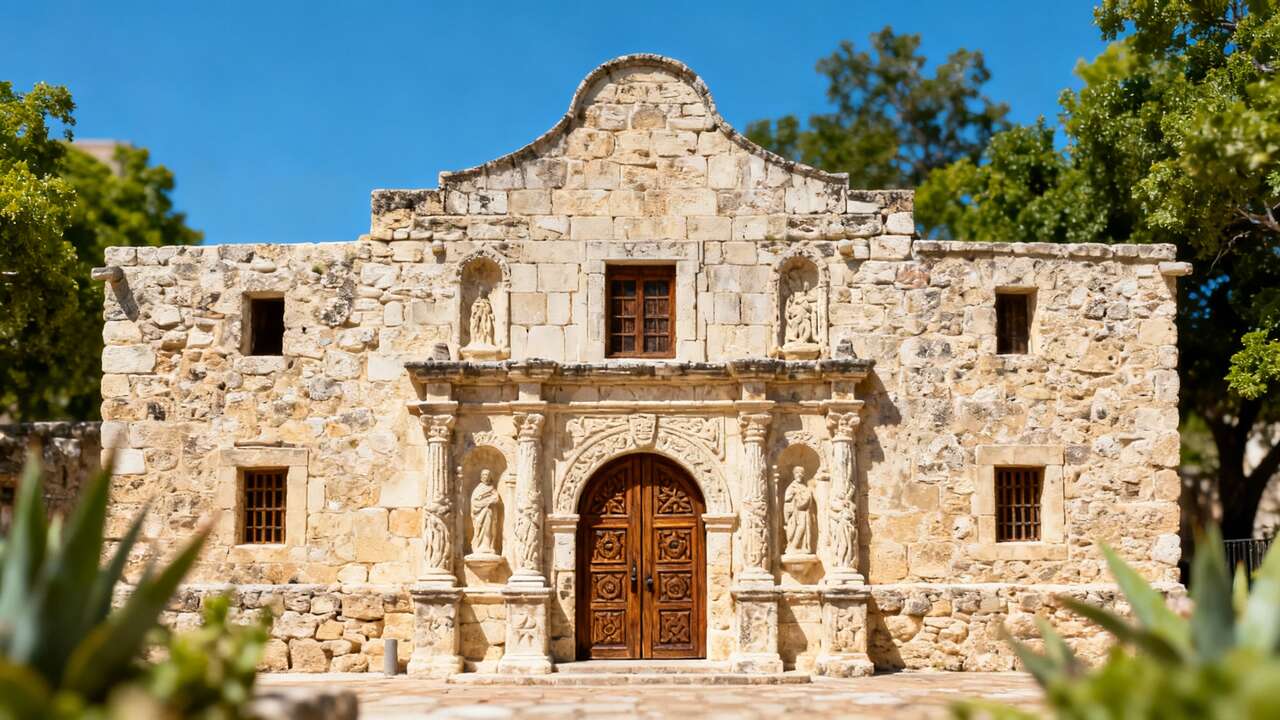

In the heart of San Antonio stands a limestone structure that is more than just a historic building; it is the cradle of Texan liberty. This former mission, turned fortress, witnessed a pivotal battle that forged an enduring legacy of courage and sacrifice. Its weathered walls tell a story of defiance against overwhelming odds, a narrative that has become central to the identity of a state and a powerful symbol of the fight for independence. Today, it remains one of the nation’s most visited historic landmarks, a hallowed ground where the echoes of a revolutionary struggle still resonate.
History of the Alamo: a focal point in the fight for independence
From religious mission to military outpost
The story of the Alamo begins not as a fortress, but as a place of spiritual conversion. Founded in 1718, it was originally known as Mission San Antonio de Valero. Its primary purpose was to serve as a hub for Franciscan missionaries aiming to convert and educate local Native American populations. For over seven decades, it functioned as a religious and agricultural community. However, by the end of the 18th century, the mission system was in decline. In 1793, its religious functions ceased, and the property was secularized. The early 1800s marked a significant transformation when a Spanish cavalry unit from a town called Alamo de Parras was stationed there, giving the compound its now-famous name. From that point forward, the Alamo’s destiny was intertwined with military conflict, serving as a garrison for a succession of armies.
The seeds of revolution
By the 1830s, Texas was a province of Mexico, but its population was increasingly composed of Anglo-American settlers. Tensions mounted between these settlers and the central Mexican government over issues of governance, immigration, and slavery. The situation escalated when the Mexican president moved to dissolve the federalist constitution of 1824 and establish a more centralized, authoritarian rule. This action was the final catalyst, sparking the Texas Revolution in 1835. Settlers, known as Texians, organized militias to resist what they viewed as tyranny. The Alamo, strategically located in San Antonio de Béxar, quickly became a critical defensive position for the burgeoning Texan forces, setting the stage for one of the most legendary confrontations in American history.
The site’s strategic importance ensured it would become a flashpoint in the conflict, a place where the struggle for control would ultimately define the character of the revolution.
The Alamo: symbol of Texan resistance
The thirteen-day siege
In late February 1836, the Mexican army, numbering in the thousands and led by its commanding general, arrived in San Antonio to quell the rebellion. Inside the Alamo, a vastly outnumbered garrison of roughly 200 Texan defenders prepared for a siege. The defenders included a mix of Texian volunteers and American adventurers, among them a famous frontiersman and a co-commander known for his distinctive knife. For thirteen days, this small force held out against a relentless bombardment and repeated assaults. The garrison’s young commander penned a famous letter addressed “To the People of Texas and All Americans in the World,” a defiant plea for aid that declared he would never surrender or retreat. Despite his appeal, significant reinforcements never arrived.
| Force | Estimated Number of Soldiers |
|---|---|
| Texan Defenders | Approximately 200 |
| Mexican Army | Over 2,500 |
A legendary last stand
In the predawn hours of March 6, 1836, the final assault began. The Mexican army stormed the fortress from all sides. The fighting was brutal and hand-to-hand, but the outcome was inevitable. Within a short time, the Alamo had fallen, and nearly all of its defenders were killed. While a catastrophic military defeat, the battle had a profound and immediate impact on the Texan cause. News of the defenders’ sacrifice and the perceived cruelty of the victors spread like wildfire. The cry “Remember the Alamo ! “ became a powerful and unifying rallying call. It galvanized Texan resolve, inspiring a surge of volunteers to join the army and fueling a burning desire for retribution that would be realized just weeks later.
The story of this heroic last stand transformed the old mission into a sacred symbol, and today it stands as a monument to those who fought there, drawing millions who wish to connect with its powerful history.
A must-visit place in San Antonio
Essential visitor information
Located prominently in downtown San Antonio, the Alamo is an accessible and essential destination for anyone interested in Texas history. A key point for visitors is that general admission to the Alamo Church is free, though it requires a timed entry reservation to manage crowd flow. These reservations can be easily made online in advance. The site is open year-round, with hours that may vary seasonally. Due to its central location, it is well-served by public transportation, and numerous parking facilities are available nearby. Visitors should plan for at least a couple of hours to fully appreciate the grounds and the main exhibits, though a deeper dive could easily fill half a day.
Enhancing your experience
While basic entry is free, the Alamo offers several paid experiences that provide a more in-depth understanding of its history. These options are highly recommended for a comprehensive visit.
- Guided Tours: Led by knowledgeable docents, these tours offer detailed narratives about the site’s history, the battle, and the lives of those who were there.
- Audio Tours: For those who prefer to explore at their own pace, self-guided audio tours provide rich historical context and storytelling directly through a personal device.
- Special Exhibits: The Alamo often hosts temporary exhibits that focus on specific aspects of its history or display rare artifacts, which may require a separate ticket.
These enhancements transform a simple visit into a memorable educational journey, allowing guests to engage more deeply with the site’s complex past.
Once on the grounds, visitors will find a wealth of exhibits and historic structures that bring the dramatic story of the Alamo to life.
Explore the exhibits at the Alamo
The iconic church and long barrack
The most recognizable structure on the site is the Alamo Church. Its famous facade is an enduring image of Texas. Inside, visitors can walk on the same ground where defenders made their final stand. The space is treated with reverence, a quiet sanctuary honoring their sacrifice. Adjacent to the church is the Long Barrack, the oldest building on the site, dating back to the original Spanish mission era. It served as quarters for missionaries and later as a hospital and barracks for soldiers. Today, it houses a museum that chronicles the Alamo’s entire history, from its time as a Native American community to its role in the Texas Revolution and beyond. These two buildings form the historic core of the visitor experience.
Artifacts that tell a story
The Alamo’s collection of artifacts provides a tangible connection to the past. The exhibits showcase a range of historical items, including weapons used during the battle, personal effects of the defenders, and important documents from the revolutionary period. Seeing a flintlock rifle, a faded letter, or a cannonball recovered from the site makes the history feel immediate and personal. In recent years, a state-of-the-art collections center has been established to house and display a vast array of artifacts donated by private collectors and discovered through archaeological work. This collection ensures that the stories of the Alamo and its people are preserved and shared with future generations, offering a detailed glimpse into the lives and struggles of the era.
Beyond the static displays, the Alamo also offers dynamic programs that allow visitors to see history in action.
Immerse yourself in the living history of the Alamo
Daily demonstrations and reenactments
To truly understand the world of the 1830s, the Alamo offers a robust living history program. Throughout the day, historical interpreters dressed in period clothing conduct demonstrations that bring the past to life. Visitors can witness the firing of a flintlock rifle, learn about the daily life of a soldier, or see demonstrations of frontier skills and crafts. These presentations are not just informative; they are immersive experiences that engage the senses. Hearing the crack of a rifle or smelling the smoke from a campfire provides a visceral connection to the past that cannot be replicated by reading a book or looking at an artifact in a case. These daily events make every visit unique and engaging for all ages.
A calendar of special events
The Alamo’s calendar is filled with special events that commemorate key moments in its history and celebrate its cultural heritage. The most significant of these is the annual “Commemoration of the Battle of the Alamo,” a series of solemn events held in February and March that include reenactments, musical tributes, and readings of historical accounts. Other events throughout the year might include:
- Historical symposiums and lectures from leading experts.
- Cultural festivals celebrating the diverse heritage of the region.
- Family-friendly educational days with hands-on activities.
These programs ensure that the Alamo is not just a static monument but a vibrant center for learning and remembrance, constantly offering new ways to connect with its legacy.
This commitment to education and preservation extends beyond the visible structures, reaching into the very ground the Alamo is built upon.
The hidden treasures of the Alamo’s heritage
Unearthing the past through archaeology
The Alamo grounds are an active archaeological site, with ongoing research continually revealing new insights into its long and layered history. Excavations have uncovered artifacts and structural foundations from its time as a Native American settlement, a Spanish mission, and a military fortress. These discoveries help historians and archaeologists piece together a more complete picture of life at the site over three centuries. Finds have ranged from mission-era pottery to remnants of the 1836 battlements. This research is a critical part of the Alamo’s preservation plan, ensuring that future development is done with a deep respect for the historical record buried just beneath the surface. It reminds us that the Alamo’s story is still being written.
A legacy in culture and song
The Alamo’s influence extends far beyond its physical walls. It has been a subject of fascination in popular culture for generations, immortalized in film, literature, and music. In 1955, a famous folk song about the battle became a national hit, its powerful lyrics helping to cement the defenders’ story in the American consciousness. The site itself has a complex history of governance, having served as a garrison under the flags of five different nations: Spain, Mexico, the Republic of Texas, the Confederate States, and the United States. This rich heritage is a testament to its central role in the history of the region. Today, as a UNESCO World Heritage Site, the Alamo is recognized not just as a symbol of Texan independence but as a place of universal value, representing the human struggle for freedom and self-determination.
The Alamo is a profound testament to the power of symbolism and the enduring human spirit. From its origins as a humble mission to its fiery rebirth as a shrine of liberty, the site encapsulates a pivotal moment in history. Visiting the Alamo offers a direct connection to the sacrifices made in the quest for independence, making it an unforgettable pilgrimage into the heart of the Texan identity.

- This Central American country is the new Costa Rica - 1 November 2025
- This “floating” sauna in a Norwegian fjord is the ultimate Scandi experience - 1 November 2025
- Why this small US town is the “Christmas Capital” of America - 1 November 2025
Pubblicazioni simili :
 Discover the Hidden Gem Near Miami That Feels Like a World Away
 Discover the Majestic Mountains in Texas That Will Change Your Autumn Adventures
 Explore the Haunting Beauty and Unforgettable Adventure of America’s Loneliest Road in Autumn
 Why You Can’t Miss Colorado’s “Golden Rush” Autumn Spectacle This Year